Free IIA IIA-ACCA Practice Questions 2026 - Page 22

Ready for IIA-ACCA Exam?
This practice test is your final exam before the REAL exam
Dare to Take It?
Practice Questions
Practice of Internal Auditing
An internal auditor submitted a report containing recommendations for management to enhance internal controls related to investments. To follow up, which of the following is the most appropriate action for the internal auditor to take?
A. Observe corrective measures.
B. Seek a management assurance declaration.
C. Follow up during the next scheduled audit.
D. Conduct appropriate testing to verify management responses.
Which of the following statements about internal audit's follow-up process is true?
A. The nature, timing, and extent of follow-up for assurance engagements is standardized to ensure quality performance.
B. The actions of external auditors and other external assurance providers is not encompassed by internal audit's follow-up process.
C. Internal auditors have responsibility for determining if management and the board have implemented the recommended action or otherwise accepted the risk.
D. The follow-up process must be complete and documented in the working papers in order to conclude the engagement.
Which of the following is least likely to help ensure that risk is considered in a work program?
A. Risks are discussed with audit client.
B. All available information from the risk-based plan is used.
C. Client efforts to affect risk management are considered.
D. Prior risk assessments are considered.
The chief audit executive (CAE) of a small internal audit activity (IAA) plans to test
conformance with the Standards through a quality assurance review. According to the
Standards, which of the following are acceptable practice for this review?
1. Use an external service provider.
2. Conduct a self-assessment with independent validation.
3. Arrange for a review by qualified employees outside of the IAA.
4. Arrange for reciprocal peer review with another CAE.
A. 1 and 2
B. 2 and 4
C. 1, 2, and 3
D. 2, 3, and 4
Which of the following is not an outcome of control self-assessment?
A. Informal, soft controls are omitted, and greater focus is placed on hard controls.
B. The entire objectives-risks-controls infrastructure of an organization is subject to greater monitoring and continuous improvement.
C. Internal auditors become involved in and knowledgeable about the self-assessment process.
D. Nonaudit employees become experienced in assessing controls and associating control processes with managing risks.
New environmental regulations require the board to certify that the organization's reported pollutant emissions data is accurate. The chief audit executive (CAE) is planning an audit to provide assurance over the organization's compliance with the environmental regulations. Which of the following groups or individuals is most important for the CAE to consult to determine the scope of the audit?
A. The audit committee of the board.
B. The environmental, health, and safety manager.
C. The organization's external environmental lawyers.
D. The organization's insurance department.
The external auditor has identified a number of production process control deficiencies involving several departments. As a result, senior management has asked the internal audit activity to complete internal control training for all related staff. According to IIA guidance, which of the following would be the most appropriate course of action for the chief audit executive to follow?
A. Refuse to accept the consulting engagement because it would be a violation of independence.
B. Collaborate with the external auditor to ensure the most efficient use of resources.
C. Accept the engagement but hire an external training specialist to provide the necessary expertise.
D. Accept the engagement even if the audit engagement staff was previously responsible for operational areas being trained.
An internal auditor is assessing the organization's risk management framework. Which of
the following formulas should he use to calculate the residual risk?
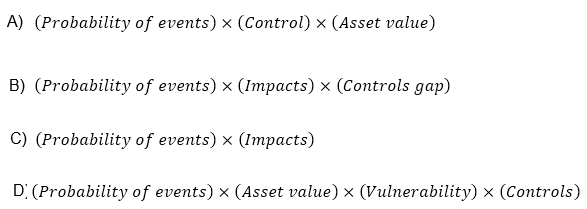
A. Option A
B. Option B
C. Option C
D. Option D
According to IIA guidance, which of the following strategies would add the least value to the achievement of the internal audit activity's (IAA's) objectives?
A. Align organizational activities to internal audit activities and measure according to the approved IAA performance measures.
B. Establish a periodic review of monitoring and reporting processes to help ensure relevant IAA reporting.
C. Use the results of IAA engagement and advisory reporting to guide current and future internal audit activities.
D. Establish a format and frequency for IAA reporting that is appropriate and aligns with the organization's governance structure.
Due to price risk from the foreign currency purchase of aviation fuel, an airliner has
purchased forward contracts to hedge against fluctuations in the exchange rate. When
recalculating the exchange losses from individual purchases of jet fuel, which of the
following details does the internal auditor need to validate?
1. The hedge documentation designating the hedge.
2. The spot exchange rate on the transaction date.
3. The terms of the forward contract.
4. The amount of fuel purchased.
A. 1 and 2
B. 1 and 4
C. 2 and 3
D. 3 and 4
| Page 22 out of 61 Pages |