Free IIA IIA-ACCA Practice Questions 2026 - Page 17

Timed Practice Test

Ready for IIA-ACCA Exam?

This practice test is your final exam before the REAL exam
Dare to Take It?


Practice Questions

Essentials of Internal Auditing

Click the Exhibit.
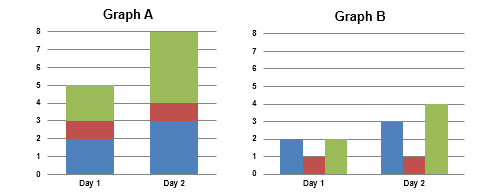
Internal auditors are asked to keep track of how many hours per day they spend planning the audit, conducting the engagement, and writing the audit report. The data for two days has been collected as follows:

Day 1
Day 2
Planning the audit
2 hours
3 hours
Conducting the engagement
1 hour
1 hour
Writing the audit report
2 hours
4 hours

Which of the following graphs depicts the data accurately?

A. Graph A only

B. Graph B only

C. Both A and B.

D. Neither A nor B.

C.   Both A and B.

Non-statistical sampling does not require which of the following?

A. The sample to be representative of the population.

B. The sample to be selected haphazardly.

C. A smaller sample size than if selected using statistical sampling.

D. Projecting the results to the population.

C.   A smaller sample size than if selected using statistical sampling.

A chief audit executive (CAE) reports functionally to the CEO and administratively to the chief financial officer, both of whom serve on the company's board of directors. According to IIA guidance, which of the following would offer the greatest protection for the independence of the internal audit activity?

A. Appoint the CAE as a member of the board.

B. Move the CAE's functional reporting to an executive who is not on the board.

C. Obtain full board approval of the internal audit activity's annual audit plan.

D. Move the CAE's functional reporting to the audit committee.

D.   Move the CAE's functional reporting to the audit committee.

Which of the following options is the most cost-effective and efficient way for internal auditors to keep current with the latest developments in the internal audit profession?

A. Attending annual professional conferences and seminars.

B. Participating in on-the-job training in various departments of the organization.

C. Pursuing as many professional certifications as possible.

D. Maintaining membership in The HA and similar professional organizations and subscribing to relevant email updates or news feeds.

D.   Maintaining membership in The HA and similar professional organizations and subscribing to relevant email updates or news feeds.

While preparing for an audit of senior management expenses, the chief audit executive (CAE) learns that management is unable to locate a number of original expense claims to support the related disbursements. She decides to defer the engagement until they can be located. Which of the following principles likely guided the CAE's decision?

A. Objectivity.

B. Proficiency.

C. Independence.

D. Due professional care.

D.   Due professional care.

Which of the following is an example of collusion?

A. An employee includes a faked receipt in his expense claim, and the claim is signed by the employee's manager.

B. A vendor inflates the price of an item and remits a portion of the excess to the purchasing manager.

C. A vendor sends a duplicate invoice with a new invoice number, and the accounts payable system fails to detect the duplication.

D. An employee works with the IT manager to develop a program for identifying duplicate invoice payments.

B.   A vendor inflates the price of an item and remits a portion of the excess to the purchasing manager.

An assurance mapping exercise helps an organization do which of the following?

1. Provide assurance to stakeholders that risks are managed and reported, and regulatory and legal obligations are met.
2. Fulfill best practices in the industry.
3. Identify and address any gaps in the risk management process.
4. Identify fraud.

A. 1 and 4.

B. 1 and 3.

C. 2 and 3.

D. 3 and 4.

B.   1 and 3.

According to the COSO enterprise risk management (ERM) framework, which of the following is not part of the new paradigm in ERM?

A. Assessing the risk factors.

B. Aligning risk appetite and strategy.

C. Enhancing risk response decisions.

D. Reducing operational surprises and losses.

A.   Assessing the risk factors.

Which of the following is an example of a risk management avoidance response?

A. Exiting a marketplace.

B. Recalling a product.

C. Obtaining product insurance.

D. Outsourcing production.

A.   Exiting a marketplace.

Which of the following best describes the misdirection of payments on accounts receivable to an employee's bank account?

A. Fraud open on the books.

B. Fraud hidden on the books.

C. Fraud off the books.

D. Fraud on the balance sheet.

C.   Fraud off the books.

Page 17 out of 61 Pages